 Falmouth MA · ConceptFig. 03 · Card Game · 2024 — ongoing
Brain or AI.
Falmouth MA · ConceptFig. 03 · Card Game · 2024 — ongoingBrain or AI.
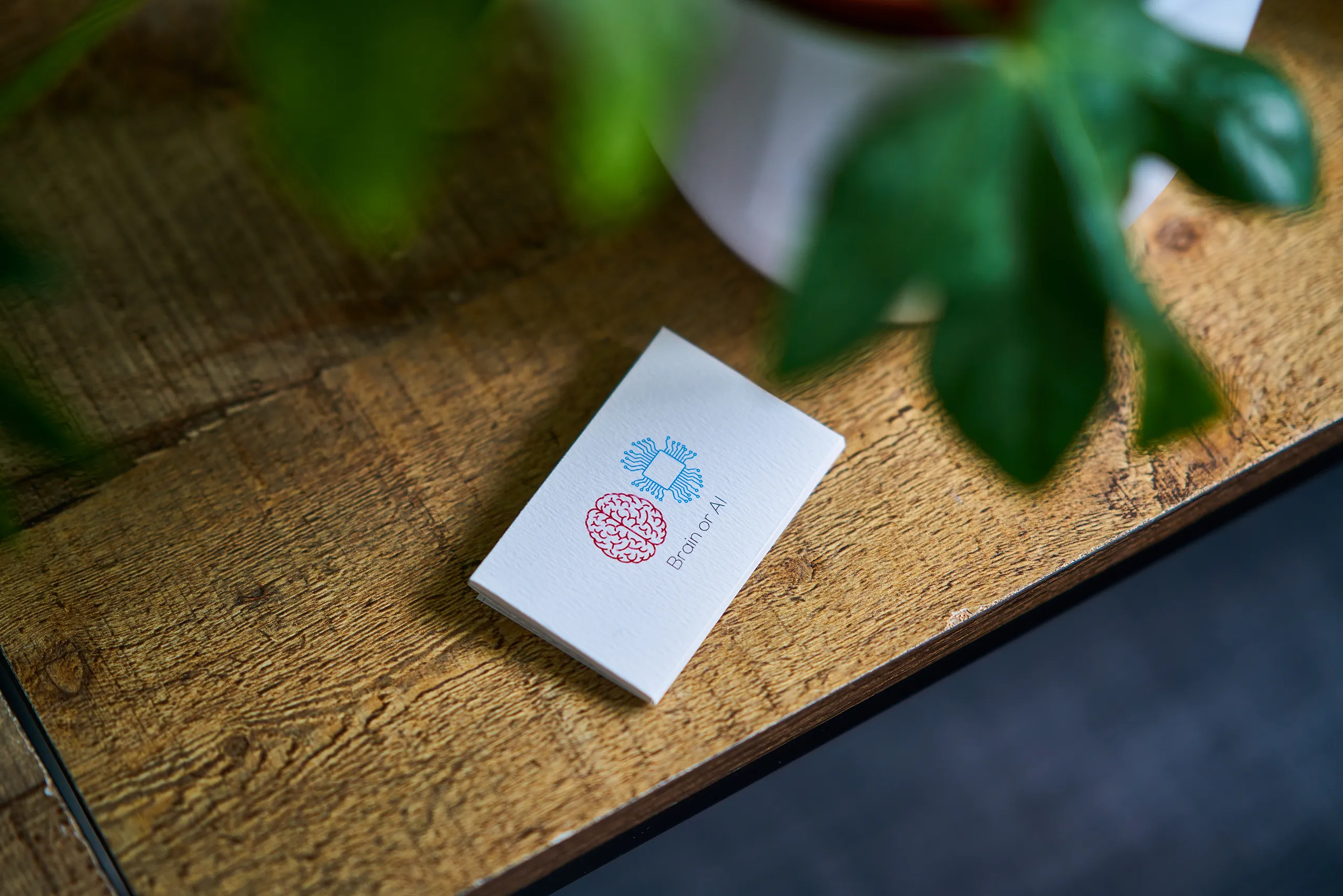
Brain or AI: Decode the Truth! is a card-based educational toolkit designed to teach children to think critically alongside AI — not to fear it, but to understand when their own brain is the better tool. The project grew from a separate frustration: AI adoption among young people is accelerating far faster than any ethical framework for using it. Using coloured decoder lenses, students compare human-centred thinking with AI-generated responses to the same question — and discover what each path costs.
Rooted in eleven years of Montessori materials design — the idea that the right object, in the right hands, teaches without explaining.
Brain or AI: Decode the Truth! is a card-based educational toolkit designed to teach children to think critically alongside AI — not to fear it, but to understand when their own brain is the better tool. The project grew from a separate frustration: AI adoption among young people is accelerating far faster than any ethical framework for using it. Using coloured decoder lenses, students compare human-centred thinking with AI-generated responses to the same question — and discover what each path costs.
Rooted in eleven years of Montessori materials design — the idea that the right object, in the right hands, teaches without explaining.
Every AI is built on an ethical framework. Every framework has been broken. The only safeguard that can’t be jailbroken is a generation that knows how to think.
Every AI is built on an ethical framework. Every framework has been broken. The only safeguard that can’t be jailbroken is a generation that knows how to think.
Of 13–17 year olds use AI tools weekly — the majority without any framework for understanding what those tools consume or how they decide.
Teachers globally who lack resources to teach AI ethics. The gap between adoption and education is widening every semester.
The age when children start using phones and face real AI decisions. The habit forms before the critical lens does — this is the window.
Of 13–17 year olds use AI tools weekly — the majority without any framework for understanding what those tools consume or how they decide.
Teachers globally who lack resources to teach AI ethics. The gap between adoption and education is widening every semester.
The age when children start using phones and face real AI decisions. The habit forms before the critical lens does — this is the window.
AI is not going away — and it shouldn't. It will develop further, become invisible inside everyday tools, and most people will use it without even knowing. But that's exactly the problem. People find loopholes in every ethical framework. They use AI to generate hate speech, misinformation, deepfakes — to damage individuals, groups, and societies. The first two parts of the Trilogy exposed the environmental cost. Brain or AI addresses the human one: if you're going to use a tool this powerful, you need to know how to think alongside it.
The brief: teach the next generation to think critically alongside AI — not to fear it, not to worship it, but to understand what it costs and when their own brain is the better tool. Current AI education explains the mechanics but never asks the ethical question. The gap between knowing how AI works and knowing when to use it is where the damage happens.
AI is not going away — and it shouldn't. It will develop further, become invisible inside everyday tools, and most people will use it without even knowing. But that's exactly the problem. People find loopholes in every ethical framework. They use AI to generate hate speech, misinformation, deepfakes — to damage individuals, groups, and societies. The first two parts of the Trilogy exposed the environmental cost. Brain or AI addresses the human one: if you're going to use a tool this powerful, you need to know how to think alongside it.
The brief: teach the next generation to think critically alongside AI — not to fear it, not to worship it, but to understand what it costs and when their own brain is the better tool. Current AI education explains the mechanics but never asks the ethical question. The gap between knowing how AI works and knowing when to use it is where the damage happens.
The research began with a question from a lecturer: ‘How does this connect to your personal practice?’ Ten years of designing Montessori materials — where children learn through physical objects, not instruction — suddenly became the answer. The investigation shifted: not what does AI cost environmentally, but what does it cost a child who never learns to question it?
Existing AI education explains the mechanics but not the ethics. Meanwhile, research on children aged 10–14 shows consistently that curiosity-state learning produces significantly stronger retention — children remember what they discover, and forget what they're told. The design direction became clear: don't lecture. Trigger the question that makes the child teach themselves.
The research began with a question from a lecturer: ‘How does this connect to your personal practice?’ Ten years of designing Montessori materials — where children learn through physical objects, not instruction — suddenly became the answer. The investigation shifted: not what does AI cost environmentally, but what does it cost a child who never learns to question it?
Existing AI education explains the mechanics but not the ethics. Meanwhile, research on children aged 10–14 shows consistently that curiosity-state learning produces significantly stronger retention — children remember what they discover, and forget what they're told. The design direction became clear: don't lecture. Trigger the question that makes the child teach themselves.
A curious child doesn’t need to be taught. They need to be triggered.
Children are born investigators. They ask why before they can spell it. They take things apart to see how they work. They structure their own play to test what’s true. Neuroscience confirms what every parent already knows: a child in a state of curiosity remembers what they learn. A child who isn’t curious forgets it before the bell rings. The toolkit didn’t need to explain AI ethics. It needed to make children curious enough to discover them.
The coloured lens doesn’t teach the lesson. It triggers the question that makes the child teach themselves.
A curious child doesn’t need to be taught. They need to be triggered.
Children are born investigators. They ask why before they can spell it. They take things apart to see how they work. They structure their own play to test what’s true. Neuroscience confirms what every parent already knows: a child in a state of curiosity remembers what they learn. A child who isn’t curious forgets it before the bell rings. The toolkit didn’t need to explain AI ethics. It needed to make children curious enough to discover them.
The coloured lens doesn’t teach the lesson. It triggers the question that makes the child teach themselves.
One question. Every card.
Think before you prompt.
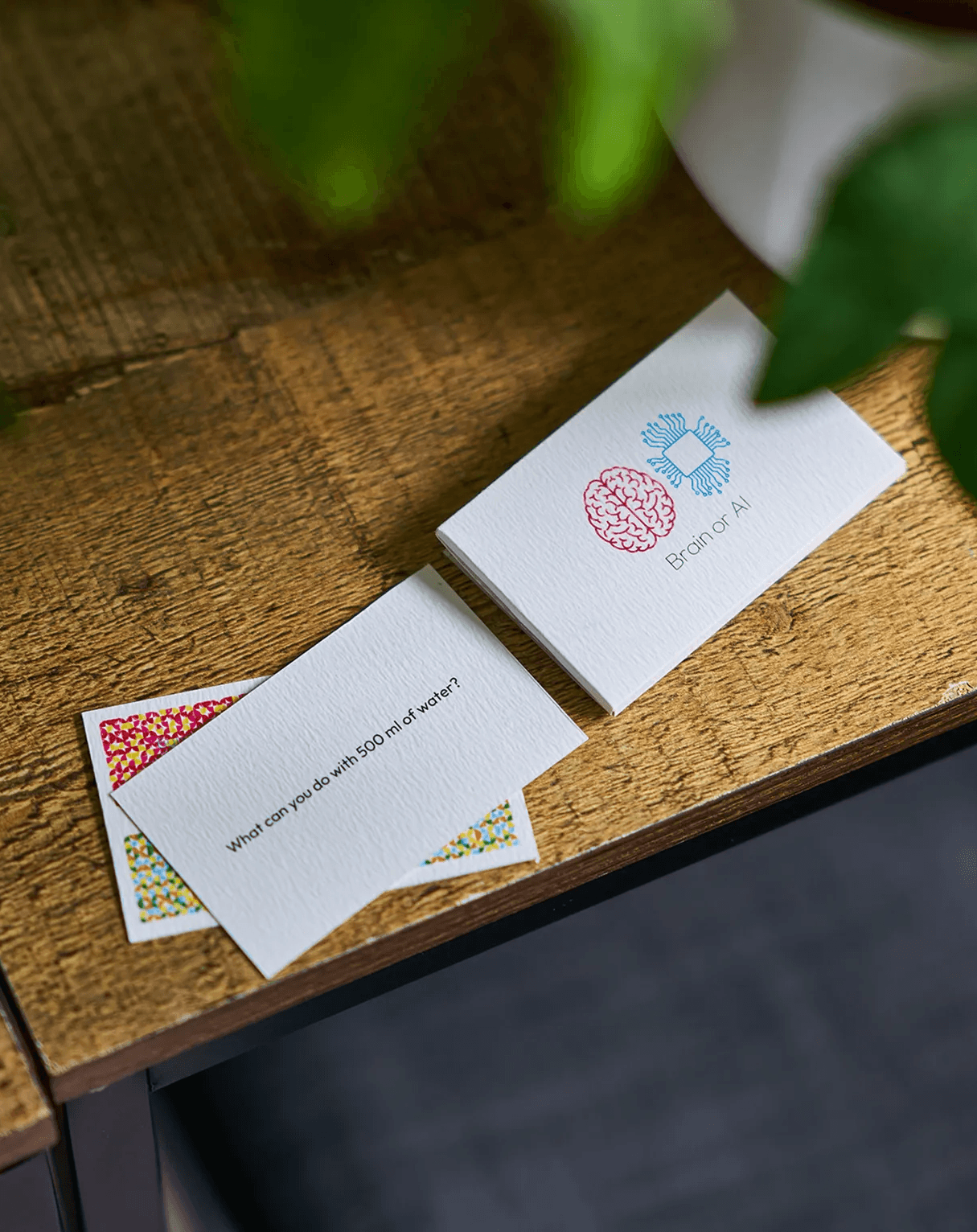
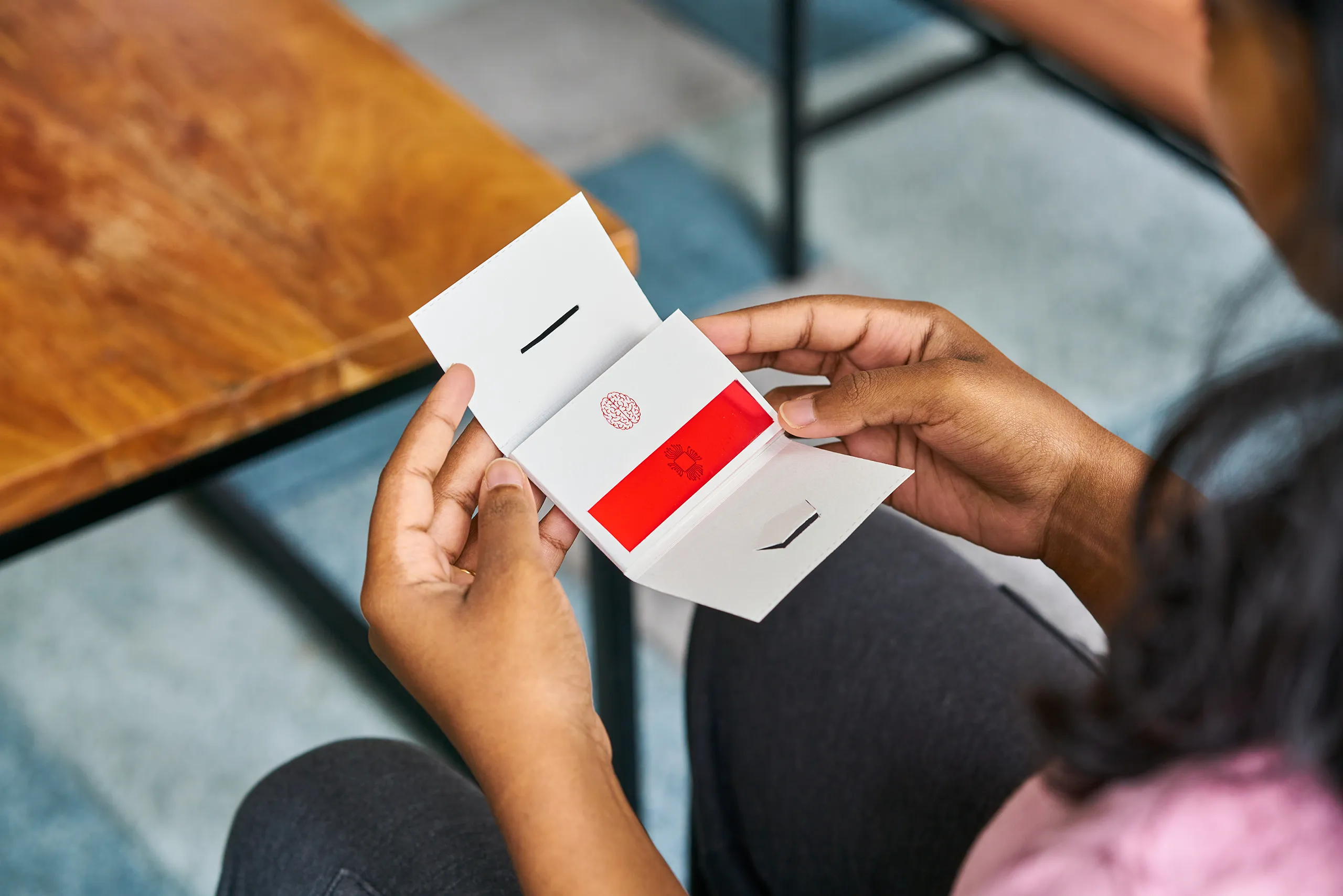
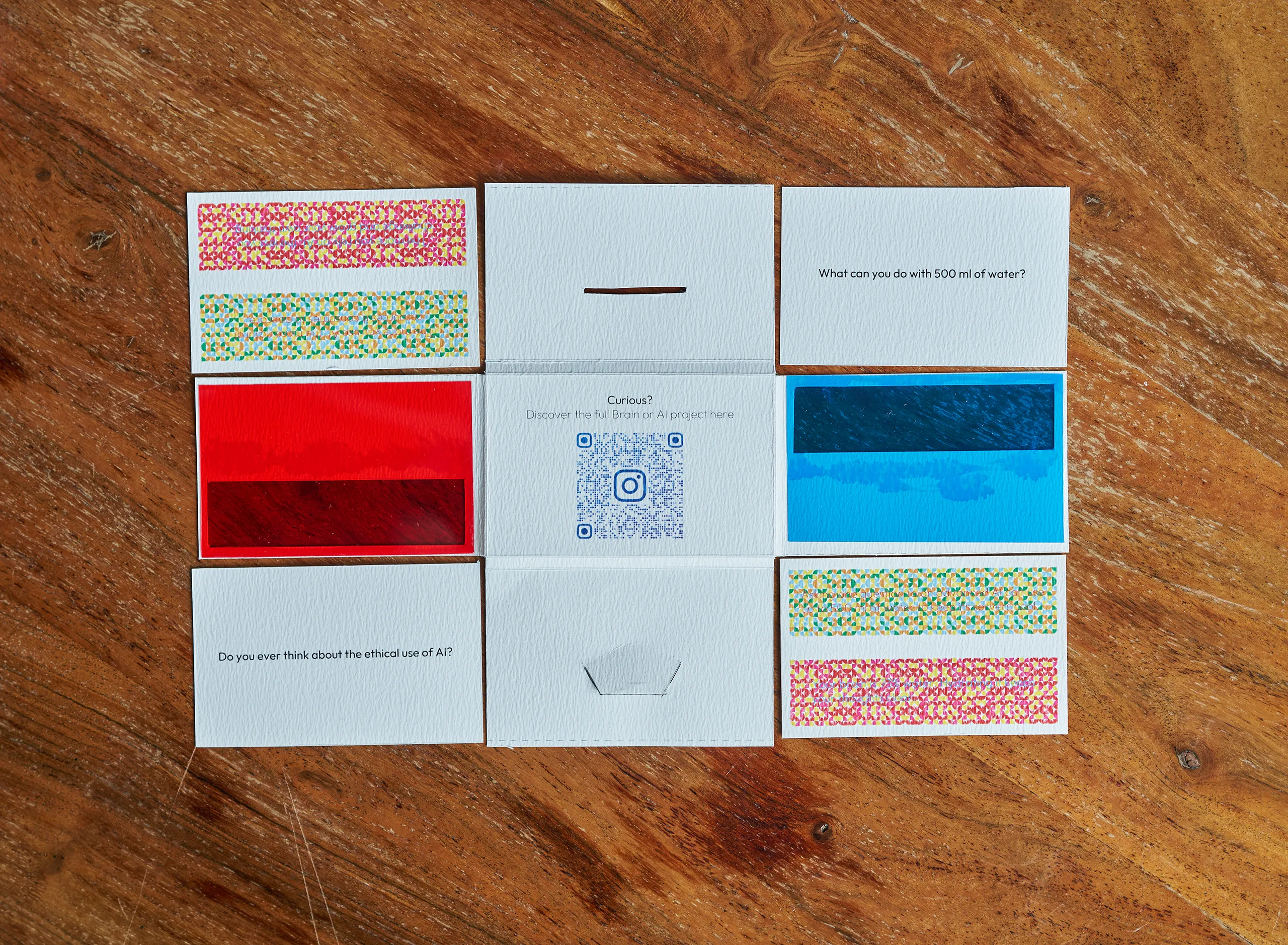
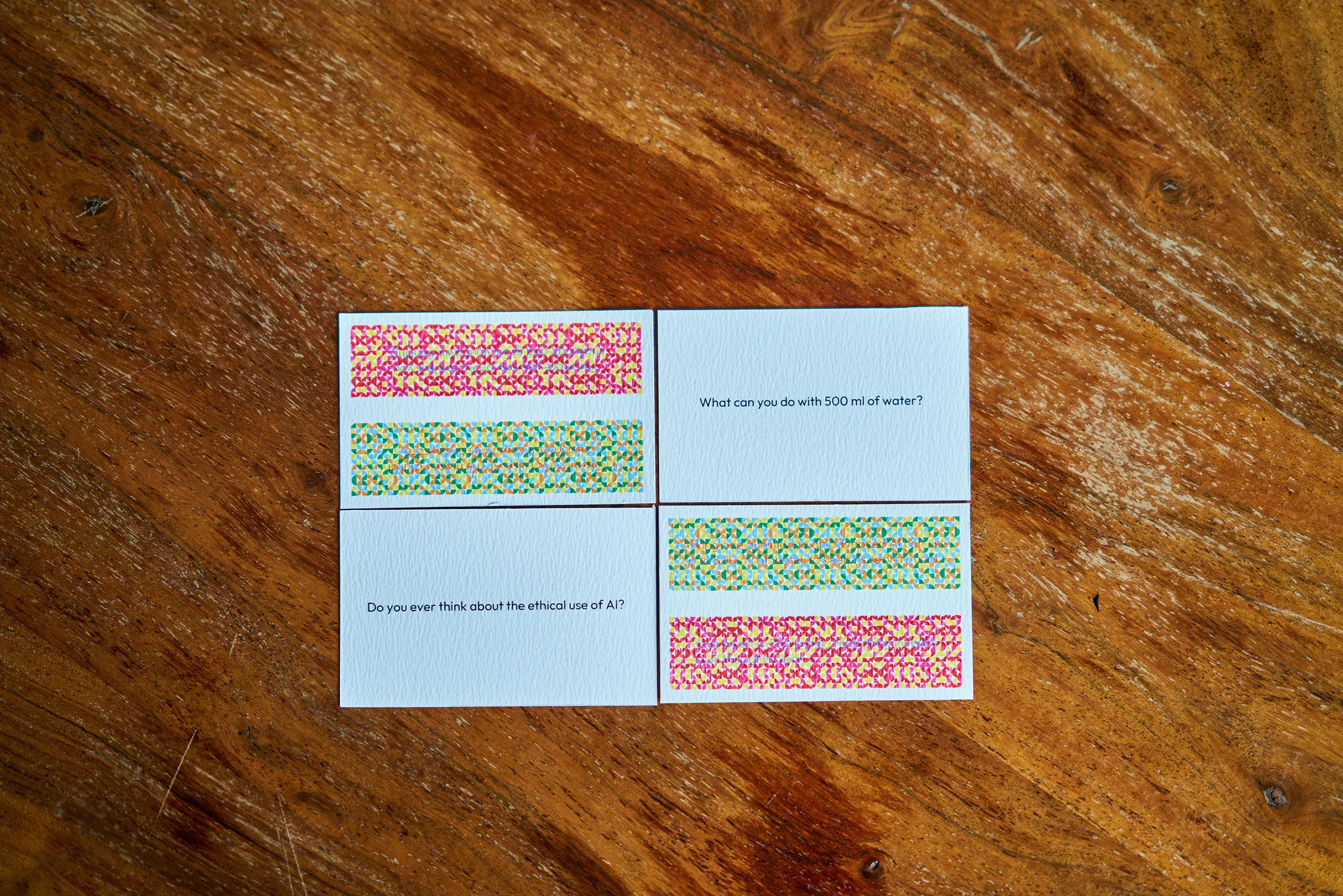
What you see here is a promotional prototype — marketing material designed to pitch the idea, not the end product targeted at children. The business card-sized envelope holds two sample cards with coloured decoder lenses, demonstrating the core mechanic: red lens reveals the human answer, blue lens reveals the AI answer plus its hidden costs. The functionality of the final toolkit is showcased through this compact format.
One question. Every card.
Think before you prompt.
What you see here is a promotional prototype — marketing material designed to pitch the idea, not the end product targeted at children. The business card-sized envelope holds two sample cards with coloured decoder lenses, demonstrating the core mechanic: red lens reveals the human answer, blue lens reveals the AI answer plus its hidden costs. The functionality of the final toolkit is showcased through this compact format.
From brief to built
Deep dive into AI's environmental footprint — power consumption, water usage, carbon emissions — combined with educational research on how children currently interact with AI tools. The ethical gap became clear: adoption is outpacing any framework for responsible use.
Interviewed three specialists: Esther Pelgrom (Montessori, AVE.IK), Clare Farion (Early Years, University of Plymouth), and Rinus Houkes (former Head of Product Design, Nienhuis Montessori). Their feedback refined the target age to 11–12+, validated the card game format, and recommended the decision-making flowchart as the umbrella framework.
Designed the card system: each card presents a real-world scenario, the player chooses Brain or AI, and coloured decoder lenses reveal the consequences of each path. The red lens shows context-rich, empathetic human answers. The blue lens shows fast AI-generated answers plus hidden environmental costs. The scoring rewards reasoning quality, not ideology.
The project needed more research and classroom testing than the timeline allowed. Rather than rushing a half-finished product, a business card-sized prototype was created — a miniature envelope holding two cards with coloured lenses. This is marketing material for pitching the idea to educators and professionals, not the final product.
From brief to built
Deep dive into AI's environmental footprint — power consumption, water usage, carbon emissions — combined with educational research on how children currently interact with AI tools. The ethical gap became clear: adoption is outpacing any framework for responsible use.
Interviewed three specialists: Esther Pelgrom (Montessori, AVE.IK), Clare Farion (Early Years, University of Plymouth), and Rinus Houkes (former Head of Product Design, Nienhuis Montessori). Their feedback refined the target age to 11–12+, validated the card game format, and recommended the decision-making flowchart as the umbrella framework.
Designed the card system: each card presents a real-world scenario, the player chooses Brain or AI, and coloured decoder lenses reveal the consequences of each path. The red lens shows context-rich, empathetic human answers. The blue lens shows fast AI-generated answers plus hidden environmental costs. The scoring rewards reasoning quality, not ideology.
The project needed more research and classroom testing than the timeline allowed. Rather than rushing a half-finished product, a business card-sized prototype was created — a miniature envelope holding two cards with coloured lenses. This is marketing material for pitching the idea to educators and professionals, not the final product.
The images and prototype shown here are promotional material created to pitch the Brain or AI concept to educators, designers, and potential collaborators. This is not the end product — the final toolkit requires further research, classroom testing, and content development. The prototype demonstrates the core mechanic and sparks the right conversations with the right people.
"Your Montessori background is a strong foundation. This is a long-term project — refine now, develop fully later."
The images and prototype shown here are promotional material created to pitch the Brain or AI concept to educators, designers, and potential collaborators. This is not the end product — the final toolkit requires further research, classroom testing, and content development. The prototype demonstrates the core mechanic and sparks the right conversations with the right people.
"Your Montessori background is a strong foundation. This is a long-term project — refine now, develop fully later."




The Trilogy found its voice. Brain or AI gives it a future.
The Trilogy found its voice. Brain or AI gives it a future.
The pivot from environmental critique to educational design — triggered by a single question — is itself the project's strongest argument: that listening changes outcomes. Ten years of Montessori experience suddenly had a purpose beyond the materials themselves. The coloured lens works because it's physical, playable, and social. Everything a lecture is not.
Take the prototype into real classrooms and real conversations.
The pitching material has already opened conversations with educators and industry professionals who recognise the gap this addresses. The next step is real classrooms — pilot sessions across different age groups and school contexts to test whether the mechanic holds outside a design presentation. The content library needs building: 50–100 scenario cards across subjects. And the same manufacturing discipline that eleven years of Montessori work taught applies here — the quality of the object carries the argument.
The Trilogy found its voice. Brain or AI gives it a future.
The Trilogy found its voice. Brain or AI gives it a future.
The pivot from environmental critique to educational design — triggered by a single question — is itself the project's strongest argument: that listening changes outcomes. Ten years of Montessori experience suddenly had a purpose beyond the materials themselves. The coloured lens works because it's physical, playable, and social. Everything a lecture is not.
Take the prototype into real classrooms and real conversations.
The pitching material has already opened conversations with educators and industry professionals who recognise the gap this addresses. The next step is real classrooms — pilot sessions across different age groups and school contexts to test whether the mechanic holds outside a design presentation. The content library needs building: 50–100 scenario cards across subjects. And the same manufacturing discipline that eleven years of Montessori work taught applies here — the quality of the object carries the argument.